
If you have a radio amateur living next door, sooner or later you may have asked yourself a few questions. Why does he have so many antennas? Why does one of them occasionally rotate? Why is the light in his radio room still on at three o’clock in the morning? And, above all, who on earth is he talking to?
Relax. He is probably not communicating with aliens, intercepting secret military transmissions, or trying to contact a ship lost somewhere in the Atlantic. He is most likely taking part in a DX Contest. “Most likely” being the important part, because DX Contesting can sometimes look rather strange to anyone watching from outside.
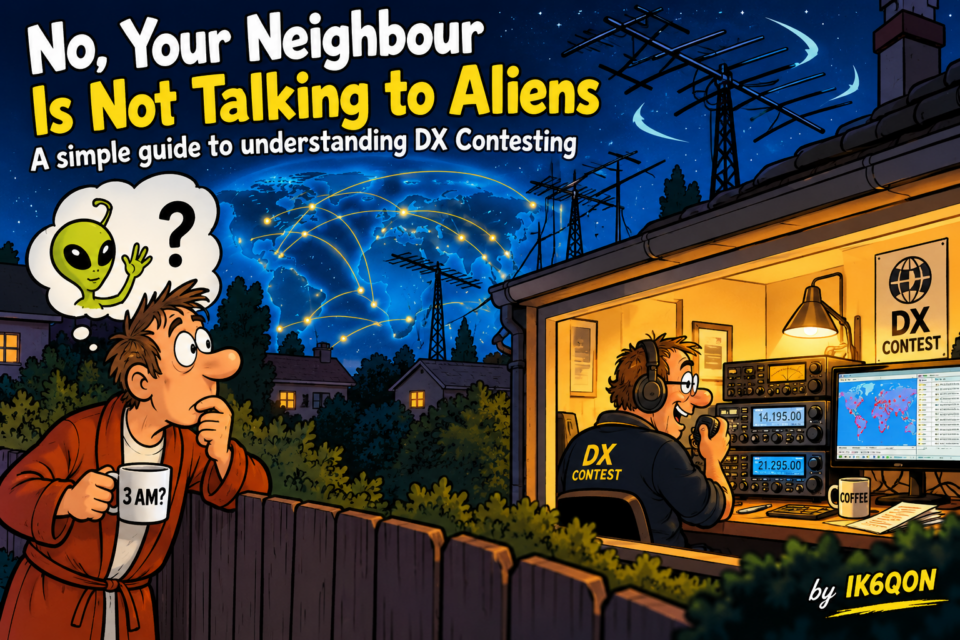
So, what exactly is a DX Contest?
Imagine a worldwide competition in which thousands of people try to contact as many other radio stations as possible, spread across the entire planet. They do this using radios, antennas, headphones, computers and, quite often, an impressive amount of coffee.
That, in very simple terms, is a DX Contest. In amateur radio language, DX usually means long-distance radio communication. So if your neighbour suddenly shouts “Japan!”, it does not necessarily mean he has just booked a holiday. He has probably just contacted a Japanese amateur radio station.
And no, the contact itself does not happen through the Internet, WhatsApp or a mobile phone. It happens directly by radio. A signal leaves the antenna, travels upward, interacts with the ionosphere and, under the right conditions, returns to Earth hundreds or even thousands of kilometres away.
In other words, your neighbour sends radio waves towards the sky and hopes the upper atmosphere is in a cooperative mood. Surprisingly, it often is.
That is how an amateur radio station in Europe can contact North America, South America, Africa, Asia, Oceania or a tiny island somewhere in the Pacific, without the Internet being part of the actual radio path.
What do they talk about?
Here comes the first disappointment. If you imagine conversations such as “Good evening Tokyo, how is the weather over there?”, you are probably imagining the wrong activity.
During a contest, contacts are deliberately very short. A typical exchange might sound something like “IK6QON, 59 15.” followed by “Roger, 59 25.” And that is it. Next station.
Romance: almost zero. Efficiency: extremely high.
The goal is not to have a long conversation. The goal is to complete as many valid radio contacts as possible. When conditions are good, an experienced operator can make hundreds of contacts in a single hour.
So if you hear your neighbour repeating his callsign every few seconds, he has not forgotten who he is. He is calling CQ.
And what is CQ?
That is basically radio language for: “Anyone out there want to talk to me?”
During a big contest, however, the answer can sometimes be: “Yes. Three hundred of us.”
That creates what radio amateurs call a pile-up: many stations calling the same station at exactly the same time. If you want a non-radio comparison, imagine a crowded room where fifty people are simultaneously trying to get the attention of one person.
Or, perhaps more accurately, imagine a condominium meeting. Except this one involves several continents.
Is it really a competition?
Absolutely. There are rules, categories, official logs, scores and final results. Some contests last only a few hours, others 24 hours, while the largest international competitions may last 48 consecutive hours.
Yes. Forty-eight.
This is usually the moment when the neighbour starts behaving in a way that ordinary people may consider slightly unusual. Sleep? Possibly. Food? Quickly. Telephone calls? Depends on what is happening on 15 metres.
Propagation: the invisible referee
Propagation is one of the reasons DX Contesting is so fascinating, and occasionally so frustrating.
HF radio signals depend heavily on the ionosphere and solar conditions. A band that allows excellent communication with the United States at 20:00 might be almost completely dead an hour later. Another band that seemed useless during the afternoon may suddenly open towards Japan.
Contest operators therefore spend a lot of time asking themselves questions such as “Where can I work right now?”, often followed shortly afterwards by “Why was California booming in twenty minutes ago and now I can hear absolutely nothing?”
The ionosphere has a remarkable ability to remind radio amateurs who is really in charge.
Why does the antenna rotate?
Because many amateur radio antennas are directional. That means they concentrate both transmitted and received signals in a particular direction.
Point the antenna west from Europe and you may be looking for North America. Turn it towards northeast and you may be chasing Japan. Move it south and perhaps you are listening for Africa.
If your neighbour keeps turning it backwards and forwards for no obvious reason, there are several possible explanations. One of them is that the propagation has changed. Another is that he has no idea where the station he wants is coming from.
That happens too.
Why are some antennas so large?
Because radio signals arriving from the other side of the world can be extremely weak. A good antenna system improves both transmission and reception, and reception is often the more important part.
It is one thing to transmit a strong signal. It is another thing entirely to understand someone calling you from 10,000 kilometres away while dozens of other stations are transmitting nearby.
A good antenna can therefore make the difference between “Got him first call!” and “I heard him for twenty minutes and then he disappeared.”
The second sentence is very common in amateur radio.
Why does he need more than one radio?
Because apparently one radio was not complicated enough.
Modern contest stations may use two radios, while multi-operator stations may use several of them. One radio may be used to call continuously on one band while another is used to search for new stations and multipliers.
Meanwhile, computers record contacts, display information, control radios and help operators manage strategy. A serious contest station can therefore look surprisingly similar to a small control room: multiple screens, several radios, headsets, switches, amplifiers, filters, rotators and cables everywhere.
To the untrained eye, NASA seems the most obvious explanation.
In reality, everyone may simply be trying to work Nebraska on 20 metres.
And what exactly are multipliers?
Now things become slightly more serious.
In many DX contests, the score is not determined only by the number of contacts. Certain countries, zones, states, regions or other geographical areas can act as multipliers.
This means that one particular contact may have much more strategic value than another. So when your neighbour suddenly gets very excited because he has worked one station after ignoring twenty others, there may be a perfectly rational explanation.
That station was probably a new multiplier.
At least, rational by contest standards.
Thousands of stations, one global playing field
During the biggest international contests, thousands of amateur radio stations may be active across the world: Europe, North America, South America, Asia, Africa and Oceania.
For a weekend, the HF bands become a huge global arena. Everyone is listening, everyone is calling and everyone is looking for the next contact. And sooner or later, everyone seems to be chasing the same rare station operating from a small island in the middle of nowhere.
This is where contesting becomes a mix of technology, geography, strategy, operating skill and patience.
Lots of patience.
What do they win?
Here comes another surprise. Usually, not very much.
No Ferrari. No million-dollar prize. No luxury holiday.
Perhaps a plaque, a certificate, a trophy or simply the satisfaction of seeing your callsign higher in the final results.
For a contester, however, the real challenge is usually personal. Can I beat last year’s score? Can I improve my station? Can I make better decisions? Can I find the right band at the right time? Can I stay focused through the second night? And, perhaps most importantly, can I finally work that multiplier I missed last year?
So why do people do it?
Because DX Contesting combines many different things: radio engineering, electronics, antennas, computers, geography, solar activity, strategy, operating skill, fast decision-making and endurance.
It is a technical sport where the competitors may be thousands of kilometres apart and where the playing field is constantly changing.
No two contests are exactly the same. The station may be identical. The antennas may be identical. The operator may be identical.
But the ionosphere never signs a contract.
And then there is the second night…
Anyone who has operated a long contest knows there is a particular moment when everything begins to feel slightly surreal.
It is four in the morning. You have been listening to noise for hours. Your coffee stopped working several countries ago. Suddenly, through the static, you hear a weak callsign.
You listen again.
It is a new country.
Instantly you are completely awake.
You call. Nothing.
Again. Nothing.
Then finally:
“IK6QON, 59…”
And suddenly the last three hours of suffering were absolutely worth it.
Try explaining that to someone who does not do contests.
Actually, that is exactly why we wrote this article.
So, dear neighbour…
The next time you see the big antenna rotating at eleven o’clock at night, do not worry. It is probably looking for North America.
If the light in the radio room is still on at three in the morning, perhaps the Pacific has just opened.
And if on Sunday afternoon you meet your neighbour looking exhausted and muttering something like “I missed one multiplier on 15…”, do not ask too many questions.
Just nod sympathetically and say: “That’s a shame. Maybe next contest.”
You will probably make his day.
Because, in the end, DX Contesting is simply this: thousands of people trying to cross the planet with a radio signal, competing against other stations, the clock, propagation conditions and, occasionally, themselves.
So no. Your neighbour is probably not talking to aliens.
He is a contester.
Which, admittedly, may not make the situation much easier to explain.
73, Francesco, IK6QON
EUDXCC – European DX Contest Club