
A slightly ironic guide to the curious practice of Log Washing in DX Contesting
There are many things a radio amateur should probably wash after a 48-hour DX contest. His coffee cups, certainly. His clothes, quite possibly. Himself, almost definitely.
His contest log? Well, apparently, we need to talk about that.
Just a few days before the CQ WW CW Contest, John Dorr, K1AR, CQ WW Contest Director, published a statement addressing a practice known as Log Washing. For those unfamiliar with the expression, it has absolutely nothing to do with coffee accidentally spilled on a keyboard. Unfortunately.
What exactly is Log Washing?
Imagine spending an entire weekend in your radio room. You have made thousands of QSOs, survived two nights of questionable sleeping habits, consumed enough coffee to support a small South American economy and listened to CW signals under conditions that would make an ordinary human being question your mental health.
Finally, the contest is over. You look at your log, and it is beautiful. Well, almost. There are some suspicious callsigns, a few questionable exchanges and perhaps a station from a country that, according to your interpretation of Morse code at four in the morning, does not officially exist.
What do you do? Traditionally, you submit your log and accept the consequences. But apparently, some people have discovered an alternative: washing it.
Not with water, obviously, but with databases, software, recordings and other sources of information that allow mistakes to be corrected after the competition has ended.
The result is a cleaner log, fewer penalties and potentially a better score. The only small inconvenience is that this kind of retrospective correction is against the rules.
Welcome to the DX Contest Laundry
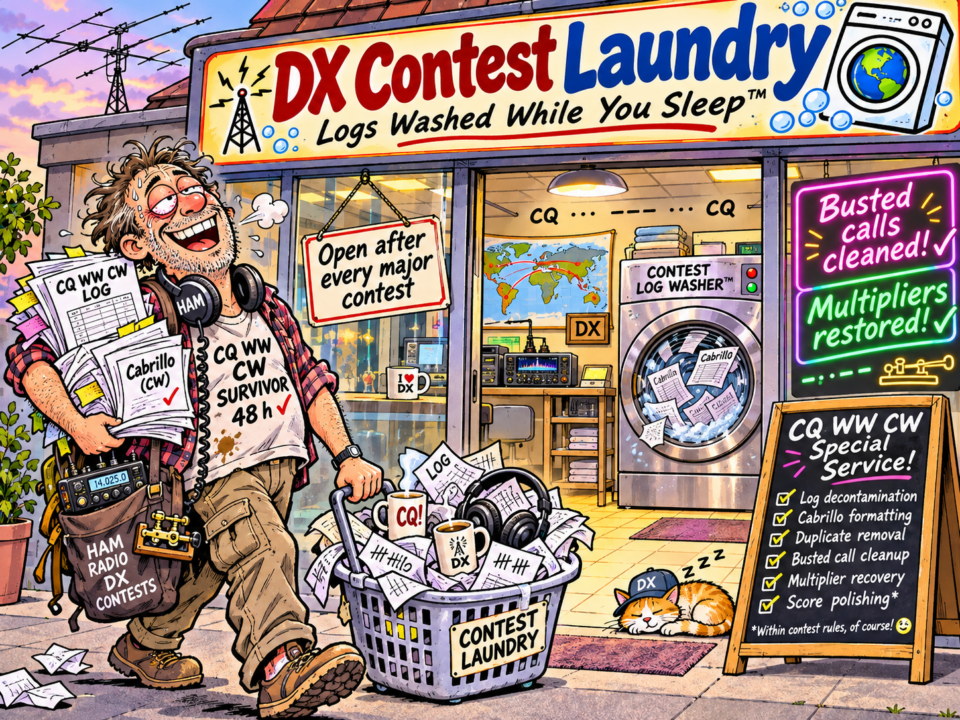
Imagine a new commercial activity appearing in the amateur radio world, conveniently opening every Sunday evening immediately after the major international contests: the DX Contest Laundry.
Open 24 hours, operating on all bands and all modes, this revolutionary service would offer everything from the removal of stubborn busted callsigns to the deep cleaning of questionable exchanges. Rare multipliers could receive a special restoration treatment, while particularly ambitious operators might opt for a premium Cabrillo polishing service, complete with an extra spin cycle for particularly optimistic claimed scores.
One could even imagine the advertising campaign: You worked the world. We’ll make sure you worked it correctly.
Unfortunately, the CQ WW Contest Committee does not appear particularly enthusiastic about this new business model.
But I only corrected a few mistakes…
Of course. And a marathon runner could probably shorten the last kilometre a little. After all, he has already run forty-one. A chess player could reconsider a particularly unfortunate move after the game, while a golfer could move the ball a few centimetres closer to the hole when nobody is looking.
In each case, the correction might appear insignificant. But there is a rather inconvenient detail: a competition is supposed to measure what you actually achieved, not what you might have achieved under slightly more favourable circumstances.
In DX Contesting, copying a callsign correctly is part of the competition. Understanding an exchange through QRM, recognising a weak signal, asking for a repeat and deciding whether a QSO has been completed are all essential elements of an operator’s skill.
Removing these difficulties afterwards is rather like playing a game of chess with the possibility of correcting your moves on Monday morning. Suddenly, we are all grandmasters.
The famous second night
Anyone who has operated a 48-hour CW contest knows that there is a particular moment when the relationship between the human brain and cw becomes somewhat complicated.
It is four in the morning, the band is noisy, your headphones have become part of your anatomy, and your coffee stopped working somewhere between the Caribbean and the west coast of the United States.
A weak station calls you. You copy the first part of the callsign, ask for a repeat and listen again. Was that an H or a 5? A B or a 6? You are reasonably confident, although your brain is beginning to process Morse code with the efficiency of a Windows computer attempting to install an update.
You press Enter and move on to the next station. Was the callsign correct? Perhaps.
That uncertainty is precisely what makes contesting a competition between human operators. We all experience those moments when propagation, interference, fatigue and our own limitations come together to make a seemingly simple QSO surprisingly difficult.
If we remove that uncertainty on Monday morning, sitting comfortably in front of a computer with a fresh cup of coffee and access to multiple databases, what exactly were we testing on Sunday morning? Our operating skills or our ability to perform administrative corrections?
The miraculous Monday morning recovery
There is something fascinating about modern technology.
On Sunday night, a contester may be incapable of remembering where he left his glasses, whether he has eaten dinner or even what day of the week it is. His family may have already begun discussing whether he requires medical attention, and his ability to communicate in ordinary human language has deteriorated considerably.
On Monday morning, however, with the assistance of sophisticated software, he can apparently remember hundreds of callsigns with extraordinary precision, including stations he could barely hear through the noise just a few hours earlier.
Medical science should probably investigate this phenomenon. The recovery of hearing, memory and CW decoding abilities is truly remarkable. Unfortunately, it occurs after the contest.
Is software the enemy?
Absolutely not. Modern DX Contesting would be almost unrecognisable without software, and those of us who spend considerable time developing contest-related applications know how valuable these tools can be.
Logging programs, propagation prediction tools, bandmaps, statistics, Reverse Beacon Networks, antenna control systems and increasingly sophisticated analytical applications have transformed our hobby. We use technology to improve our stations, understand propagation, develop strategies and analyse our performance. And that is a good thing, provided that we respect the rules of our operating category.
Post-contest analysis is particularly valuable. Understanding why we missed certain multipliers, why we remained on the wrong band for too long or why our error rate increased during the second night can help us become better operators. Personally, I find analysing a contest almost as fascinating as participating in it, although it generally requires considerably less coffee.
But there is a fundamental difference between analysing a performance and modifying it. A tool that helps you understand your mistakes is valuable. Using that same tool to rewrite your competitive performance is something entirely different.
The problem is not necessarily the software. The problem is what we decide to do with it.
So, can I touch my log after the contest?
Yes, of course. Your Cabrillo file is not a sacred archaeological document that must remain untouched until it reaches the Contest Committee.
There are perfectly legitimate reasons to review a log before submission. Checking its format, completing administrative information, verifying the operating category and correcting the club name or operator details are entirely reasonable activities. The CQ WW FAQ also recognises limited corrections based on an operator’s own notes or memory, provided that they faithfully represent what was actually exchanged over the air.
What is not acceptable is reconstructing QSOs using external information obtained after the competition, consulting databases to resolve uncertain callsigns or using recordings and other tools to retrospectively improve the accuracy of the submitted log.
The distinction is not particularly complicated. Preparing a log for submission is one thing; improving your operating performance retrospectively is another.
Checking your postal address is administration. Magically recovering a multiplier is not.
What if everybody else is doing it?
This is one of the more interesting arguments occasionally encountered in competitive activities. If other people are washing their logs, why should I not do the same?
Well, if your neighbour drives through a red light, that does not automatically transform your traffic light into a green one. The same principle applies here.
Thousands of contesters around the world submit their logs honestly, including their mistakes, missed exchanges and incorrectly copied callsigns. Some of them have invested decades in developing their operating skills, improving their stations and learning how to extract a callsign from signals that most people would classify as atmospheric noise.
They accept penalties because they understand that accuracy is part of the challenge. They may occasionally disagree with the results of the log checking process, and some of us have probably spent more time than we would care to admit analysing an unexpected NIL or a particularly painful busted multiplier.
Nevertheless, these operators deserve respect and, above all, fair competition. The fact that someone else might not respect the rules is not a particularly convincing reason to abandon our own principles.
The artificial intelligence washing machine
With the development of artificial intelligence, things could become even more interesting.
Perhaps one day someone will develop a domestic appliance specifically designed for contesters. Naturally, it would come equipped with Wi-Fi connectivity, automatic Cabrillo recognition and a selection of sophisticated washing programmes.
The Quick Wash programme would be sufficient for a small weekend contest, while the Intensive Wash would be specifically designed for the 48-hour CQ WW. A Delicate Cycle would carefully restore rare multipliers without damaging the surrounding QSOs, and the most expensive model would feature an AI Ultra Clean programme for operators who would prefer not to know what they actually copied during the competition.
Simply insert a Cabrillo file, press Start and wait until your operating skills have been digitally improved. Perhaps the machine could even print a certificate, saving the Contest Committee some additional administrative work.
The only remaining question would be whose callsign should appear on it: yours or the software developer’s?
What are we actually competing for?
Let us remember something that occasionally gets lost somewhere between a pile-up on 20 metres and the search for a multiplier on 160.
In most amateur radio contests, the prize is a certificate, a plaque, a trophy or perhaps the satisfaction of seeing our callsign somewhere near the top of a table. There are no million-dollar contracts, no Ferrari waiting outside the radio room and no Olympic sponsorship. Nobody is going to offer us a luxury apartment in Monaco because we managed to work an additional multiplier on 80 metres.
In fact, explaining the importance of that particular multiplier to someone outside the amateur radio community would probably be a challenge in itself.
And yet, some operators may be tempted to compromise their credibility for a few extra lines in a ranking.
Considering the thousands of euros we spend on radios, amplifiers, towers, antennas, coaxial cables and all the other equipment that we periodically try to justify to our families, it would be rather unfortunate to discover that the most important component of a competitive station is a washing machine.
A few words from a Contest Manager
As contest organisers, we know that checking logs is already a complex and demanding activity. Thousands of operators, hundreds of thousands of QSOs, different exchanges, clock discrepancies, typing errors and all the unpredictable situations that occur during a radio competition must be considered.
Behind every published result there is a considerable amount of work, much of which remains invisible to the participants. The objective of log checking is not to punish operators for being human, but to establish fair results using the same criteria for everyone.
An incorrectly copied callsign is not a moral failure. A missed multiplier is not a personal tragedy, although some contesters may temporarily disagree. Making mistakes is perfectly normal. Deliberately concealing them is a different matter.
At EUDXCC, we believe that the discussion raised by John Dorr, K1AR, goes well beyond the CQ WW Contest. It concerns the entire international contesting community and the credibility of our competitions.
Technology will continue to evolve, log checking techniques will become more sophisticated, and artificial intelligence will offer possibilities that we could barely imagine a few years ago. As contest organisers, we will inevitably have to deal with new challenges, reconsider certain procedures and adapt our tools to an increasingly complex technological environment.
However, the fundamental principle should remain unchanged: the score must represent the performance achieved during the competition.
A contest does not end when we finally manage to produce the perfect Cabrillo file. It ends when the contest clock reaches zero.
The beauty of an imperfect log
There is something particularly satisfying about submitting an honest contest log.
Every QSO represents a small piece of your weekend. Every multiplier reminds you of a moment when propagation, technology, strategy and operating skill came together. Even every mistake tells you something about your performance.
Perhaps you were tired, perhaps you were too confident, perhaps you should have asked for another repeat, or perhaps you should simply have gone to sleep. Probably the last one.
An imperfect log gives you something that a digitally polished log cannot: a genuine starting point for improvement.
If we systematically eliminate our mistakes before submitting our logs, we also eliminate part of the opportunity to understand our weaknesses. We may improve our position in the results, but we will not necessarily become better operators.
And improving our own abilities is, after all, one of the reasons we participate in contests. Otherwise, we could simply compare the specifications of our stations, calculate a theoretical score and spend the weekend doing something considerably more relaxing. But where would be the fun in that?
So, dear contester…
When the CQ WW CW finishes next weekend, switch off your amplifier, save your log, prepare your Cabrillo file and submit it.
Then go and have a shower, enjoy a proper meal, talk to your family and try to remember what life was like before the contest started. If you discover that your family has changed the Wi-Fi password during your absence, try not to take it personally.
If you really feel the need to use a washing machine, there are probably forty-eight hours’ worth of clothes waiting for you. Leave the Cabrillo file out of it.
Because the best contest log is not necessarily the cleanest one. It is the honest one.
73, Francesco, IK6QON
EUDXCC – European DX Contest Club