
A conversation with Fabio Schettino, I4UFH, creator and manufacturer of the RSC system
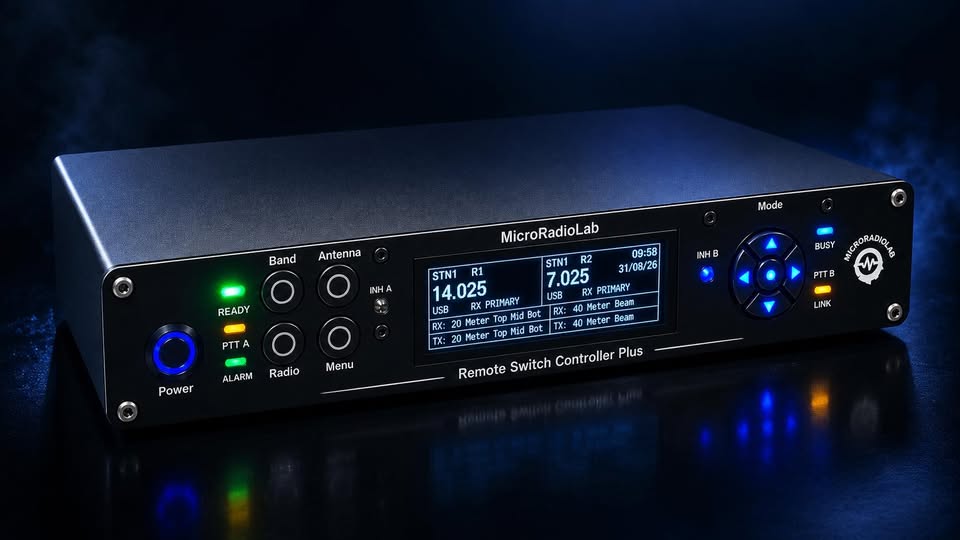
A few days ago, I had a long and very interesting conversation with Fabio Schettino, I4UFH, the creator and manufacturer of the Remote Switch Controller system, better known simply as RSC.
Fabio Schettino is a fascinating figure in the world of amateur radio contesting. With more than 45 years in the hobby, he has continually pushed the boundaries of competitive operating—from masterminding major Multi-Multi operations at IG9A on the island of Lampedusa to contributing to record-setting performances from the renowned D4C contest station in Cape Verde.
He is not only a top-tier contester but also a skilled technical innovator. Over the years, Fabio has developed log-analysis software and SO2R switching devices that have helped raise operating standards and improve station efficiency for contesters around the world.
His international contesting record includes second place worldwide in 1995, operating as IG9R in the Single Operator Single Band 20 Metres category, followed by first place worldwide the following year as IG9/I4UFH in the Single Operator Single Band 80 Metres category.
Fabio’s career is also closely connected with the World Radiosport Team Championship, or WRTC, where he has served in several roles over the years: competitor, referee, organiser and member of the Judging Committee for WRTC 2022 in Italy. His long involvement with WRTC further confirms his standing within the international contesting community and his deep understanding of both high-level operating and competition integrity.
This combination of practical contesting experience and technical expertise is essential to understanding the philosophy behind RSC. It is not merely an antenna switch that can be operated remotely. It is a complete control system designed by someone who understands the real requirements of a contest station: sharing antennas between different radios, managing increasingly complex RF paths and performing fast, safe and clearly controlled band changes.
During our conversation, Fabio explained how the idea originated, how it gradually developed and how the system can be implemented step by step: starting with a simple remote switch controlled from a computer, progressing through dedicated panels and interfaces, and eventually reaching a Dashboard or smartphone application capable of performing the same operations from a different position.
The underlying principle is simple: the operator should concentrate on the radio, the pile-up and the contact, while the system takes care of relays, signal paths, cables and switching sequences.
The original idea: turning a collection of switches into an intelligent system
In the simplest amateur radio stations, antenna selection is normally performed using a manual switch. However, as the number of antennas, bands and radios increases, the situation quickly becomes more complicated.
It is no longer enough to select one of the available outputs. The station control system must know:
- which antenna can be used on the current band;
- which signal path must be activated;
- which relays must be operated;
- whether an antenna is already being used by another radio;
- whether a particular combination is permitted;
- which antenna is intended for transmission and which is for reception only.
The idea behind Remote Switch Controller arose precisely from the need to simplify this process.
RSC coordinates the selection of antennas and the devices required to connect them to the radio. It translates a command that is easy for the operator to understand—such as “40 Metre Dipole,” “Europe Yagi” or “North America Beverage”—into the correct sequence of hardware operations.
The operator does not need to remember which relay must be activated, which control line must be enabled or which switch output must be selected. The system already knows the complete path associated with each antenna.
What Remote Switch Controller does
Remote Switch Controller receives information about the band or frequency being used by the radio, identifies the antennas compatible with that operating condition and presents the operator with only the options that are actually available.
Once the operator has made a selection, RSC automatically controls the switches and relays required to establish the signal path defined in the station configuration.
The process can be summarised in four steps:
- the radio communicates the band or frequency currently in use;
- RSC identifies the compatible antennas;
- the operator selects an antenna using the preferred interface;
- the system performs the switching operation and updates the displayed status.
If a preferred antenna has been assigned to a particular band, RSC can automatically recall it when the operator changes bands. The operator still retains full control and can select another antenna from those authorised for that band.
An antenna can also be excluded when it is unsuitable for the current frequency, temporarily unavailable or already in use by another operating position.
The result is a station in which antenna selection is based on clear names and operating rules rather than on the operator’s ability to remember the entire wiring system.
From a PC-controlled remote switch to a smartphone app
One of the most interesting aspects to emerge from my conversation with Fabio was the possibility of adapting RSC to the size and requirements of each individual station.
The implementation can begin with a basic configuration in which a remote switch is controlled from a computer. Additional control methods can then be introduced without changing the central operating logic of the system.
The main available interfaces include:
| Interface | Main use |
|---|---|
| RSC panel | Direct control from the station, even without using a computer |
| Toolbar | Rapid antenna selection alongside the logging software |
| Dashboard | Complete station status display and on-screen control |
| Keypad | Immediate commands using dedicated physical keys |
| Smartphone app | Mobile control offering the same main switching functions |
These interfaces are not separate systems. They are simply different ways of controlling the same RSC configuration.
A selection made from the physical panel, the computer Toolbar, the Dashboard, the keypad or the smartphone application reaches the same control logic and produces the same switching operation.
The displayed status is also updated, allowing the operator to confirm which antenna is actually connected.
This means that the physical panel can be used during a contest, the Toolbar while operating alongside the logging software, or the smartphone when the operator is in another part of the shack or needs to check the status of the system remotely.
Whatever interface is used, the final operation remains the same: RSC identifies the requested antenna, checks that the selection is permitted and activates the corresponding signal path.
An example with two antennas
Consider a personal station equipped with:
- a dipole for 40 and 80 metres;
- a multiband vertical for the higher bands.
When the radio moves to 40 metres, RSC offers the dipole and any other antennas authorised for that band. When the operator changes to 20 metres, the system automatically updates the available options and makes the vertical selectable.
Once the antenna has been selected, the connection is established without any manual intervention on the switches.
Even in such a simple configuration, the benefit is clear: the operator can immediately see which antenna is active and reduce the risk of transmitting through an incorrect signal path.
A single control panel also makes the station easier to use for another operator who may not know every detail of its cabling.
An example with five antennas
Now imagine a station equipped with:
- a dipole for the low bands;
- a multiband vertical;
- two directional antennas aimed at different geographical areas;
- a dedicated receiving antenna.
RSC displays only the antennas intended for the current band and type of operation. The operator can quickly change from one directional antenna to another or select the RX antenna without having to reconstruct the station’s cabling mentally.
The advantage becomes even more evident during a contest or while chasing DX.
A band change updates the available options, the antenna selection activates the correct path and all the interfaces display the current status. The operator can therefore concentrate on propagation, operating strategy and the pile-up instead of managing a complicated series of switches.
MOAS: the logical description of the station
The operation of RSC is based on MOAS, the configuration format used to describe how the station is organised.
The profile contains:
- the operating bands;
- the available antennas;
- the associations between radios and antennas;
- the switching paths;
- the rules required to authorise each selection;
- the commands that must be sent to the hardware.
In practical terms, MOAS connects the antenna name displayed to the operator with the physical path that RSC must activate.
For example, the operator may simply select “Europe Yagi.” Behind that name, however, the configuration may contain all the information required to operate several relays, select the correct switch input and connect the antenna to the appropriate radio.
The operator does not need to understand the details of the profile during normal use. The configuration is prepared during installation and can be updated whenever an antenna is added, a switch is changed or the station is expanded.
The operator interface can therefore remain substantially unchanged even when the underlying hardware is modified.
This separation between the operating interface and the physical system is one of RSC’s most important characteristics. The station can evolve without forcing the operator to learn a completely new control method every time the hardware is upgraded.
RU-16 remote units
RSC’s scalability also applies to the physical distribution of its control commands.
When switches and antennas are located far from the shack, RU-16 units make it possible to place the relay outputs exactly where they are required.
Instead of running numerous control cables over long distances, the remote location can be reached through a network connection using Ethernet or fibre optic cable, together with the necessary local power supply.
An RU-16 is a remote unit equipped with 16 relays that can be installed close to the system being controlled.
This arrangement is particularly useful for controlling:
- a 4-square array;
- a group of Beverage antennas;
- a K9AY receiving system;
- an antenna switch installed at the base of a tower;
- groups of antennas located far from the shack;
- auxiliary electrical devices.
The RU-16 receives commands generated by RSC through the network and operates the required relays locally.
The operator continues to select the antenna or direction from the panel, computer, Dashboard, keypad or smartphone without having to consider the physical location of the remote unit.
For example, an operator may select one of the four directions of a 4-square array from the RSC interface. The command is transmitted through the station network to the RU-16 installed near the antenna system, where the appropriate relays are activated.
As the station grows, additional RU-16 units can be installed at different locations while retaining the same control logic and operating interface.
Not only antennas
RSC does not merely provide digital logic outputs: its outputs are implemented using relays. For this reason, the system can also control devices other than antenna switches, including:
- remote lighting;
- auxiliary power supplies;
- cooling fans;
- warning indicators;
- actuators;
- other electrical equipment used around the station.
The command circuit must, of course, comply with the voltage, current and operating limits of the RSC outputs.
If a load exceeds these limits or operates from the mains supply, the RSC output must control a suitable power relay, contactor or external interface.
In this arrangement, RSC continues to provide the control logic, while the external device switches the load safely.
This capability allows RSC to become a more complete station-control platform rather than remaining limited exclusively to antenna switching.
Main functions for a personal station
In a personal amateur radio station, RSC can provide:
- automatic recognition of the band used by the radio;
- display of only the antennas compatible with the current band;
- antenna selection from the panel, Toolbar, Dashboard, keypad or smartphone;
- automatic switching of the path associated with the selected antenna;
- a clear indication of the active antenna and system status;
- separate management of receiving antennas;
- automatic recall of a preferred antenna following a band change;
- expansion of the available outputs using RU-16 remote units;
- control of auxiliary electrical equipment;
- the ability to modify or expand the station without changing the operating method.
The system can therefore be useful even in a relatively small station with only two or three antennas. Its modular design then allows the same station to expand gradually as new antennas, towers or operating positions are added.
Expanding towards a Multi-Multi station
The same architecture can be extended to much more complex stations with several radios and a large number of antennas.
In a Multi-Multi station or during a DXpedition, several operating positions may need to share directional arrays, low-band antennas, receiving systems and switches installed at different locations.
RSC maintains coordinated control and presents each radio with only the resources compatible with:
- the band in use;
- the station configuration;
- the status of the other operating positions;
- the configured sharing rules.
The system can prevent two stations from using the same resource simultaneously when the configuration does not allow it.
This is particularly important when an antenna, amplifier, filter or RF path cannot be shared safely between two transmitters.
By adding controllers and RU-16 units connected through Ethernet or fibre optic networks, the installation can grow without changing its overall operating philosophy.
The number of radios, operators and available paths may increase, but the control method remains the same. Each operator sees only the antennas and resources that can actually be used by that operating position.
This reduces the possibility of selection errors and makes the entire station easier to understand, even during the most demanding moments of a contest.
A philosophy born from contesting experience
Perhaps the most interesting aspect of Remote Switch Controller is its underlying approach.
RSC does not require the operator to think in terms of relay numbers, switch inputs or controller outputs. Instead, it allows the operator to select the actual resource to be used.
Commands such as “USA Yagi,” “40 Metre Vertical,” “North-East Beverage” or “4-Square towards Japan” become understandable selections, behind which the system automatically performs all the necessary operations.
This philosophy clearly reflects Fabio I4UFH’s extensive contesting experience.
During a contest, the operator must be able to change bands or antennas quickly, receive clear information about the status of the station and minimise the possibility of an error.
The same principle applies to SO2R operation, Multi-Single and Multi-Multi stations: the more complex the technical infrastructure becomes, the simpler and more intuitive its interface should appear to the operator.
Fabio’s experience in major operations such as IG9A and D4C, together with his development of contest log-analysis software and SO2R switching devices, has undoubtedly contributed to this approach.
RSC is therefore not based only on theoretical station automation. It reflects real operating situations encountered in major international contests, where switching speed, reliability and clear information can directly influence the final result.
A system that can grow with the station
Another important feature of RSC is that the station owner does not need to build the complete system immediately.
A possible development path could begin with:
- a remote antenna switch controlled from a computer;
- the integration of automatic band information from the radio;
- the addition of a physical RSC panel or keypad;
- the introduction of the Toolbar and Dashboard;
- smartphone control through a dedicated mobile interface;
- the installation of one or more RU-16 remote units;
- expansion to multiple radios and shared antennas.
The station can therefore grow gradually, adding new functions only when they are required.
The central concept remains unchanged throughout this development: each antenna and device is represented as an understandable resource, while RSC manages the corresponding hardware operations.

At the end of my conversation with Fabio, one point stood out clearly: Remote Switch Controller is much more than a convenient way to select an antenna. It represents a different approach to station design—one in which the technical complexity remains in the background, while the operator is presented with simple, meaningful and immediately understandable choices.
This is perhaps the real strength of RSC. A system that may begin by controlling just two antennas from a computer can gradually evolve into a complete station-control platform, with physical panels, a Toolbar, a Dashboard, smartphone access and RU-16 units distributed around the site. As antennas, radios and operating positions are added, the system grows with them without changing the basic way in which the operator interacts with the station.
Behind this apparent simplicity lies Fabio’s long experience in international contesting.
Anyone who has operated a complex contest station knows that every additional radio, antenna and switch increases the possibility of making a mistake. RSC approaches this problem by allowing the operator to think in terms of bands, antennas and directions rather than relays, cables and switch positions. The technology remains present, but it no longer dominates the operating experience.
That is the impression I took away from my conversation with Fabio: RSC is not simply designed to automate antenna switching. It is designed to make a complex station feel simple. And in contesting—where every second matters and concentration must remain on the pile-up—that simplicity can become a genuine competitive advantage.
73 Francesco, IK6QON